

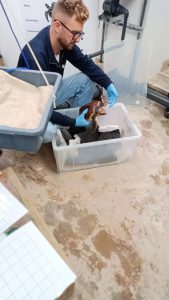
 Although we do not have any facilities ourselves to care for marine turtles, we do work closely with volunteer rescue groups like the British Divers Marine life rescue and various aquariums around the UK that care for these turtles to help them recover so they can be released back to the oceans they are from.
Due to the turtles being wild animals the aquariums that care for these must keep them in quarantine to prevent infection spreading to their marine animals. They are also unable to show the turtles due to being protected by CITES. This means that the aquariums give professional care to these turtles at great cost to themselves which we recognise and greatly appreciate.
To help we have helped produce various documentation including the turtle rehabilitation manual that gives professional advice to both rescue agencies and vets on how to assess and treat marine turtles. We also have the necessary forms to help aquariums and vets record all the details needed for the turtle database and repatriation documentation.
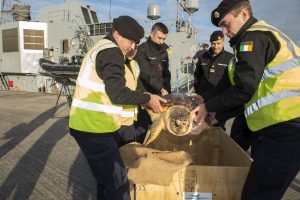
Provision 061017
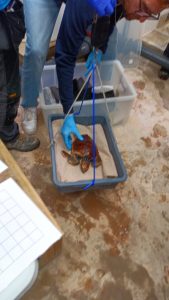
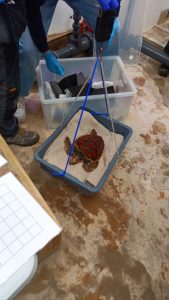
Crewmen with ‘Must Go Sally’ Loggerhead Turtle, rehabbed by Dingle Oceanworld and being loaded as the LE Niamh departs for the Meditteranean from Haulbowline with LS Wayne Ryan (dad) onboard
Pic Michael Mac Sweeney/Provision
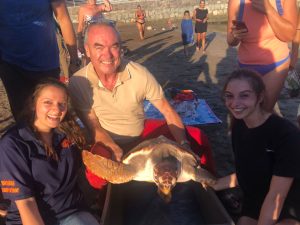 Where turtles are released depends on the species. With Kemp’s ridleys, we know where they came from. They mostly nest on a 16-mile beach in the Mexican state of Tamaulipas and on Padre Island in the US state of Texas, and elsewhere on the Gulf Coast. Historically, this species has been flown back to the USA, ideally for release into the Gulf of Mexico.
The loggerhead sea turtle is distributed all over the world, so it is not clear where this species could have come from. It is most likely that it was swept off the east coast of the USA or the Caribbean into the North Atlantic Current, only to be hit by a southwesterly storm that blew it into the cold waters of the UK/Ireland. However, it could also be from a Mediterranean population.
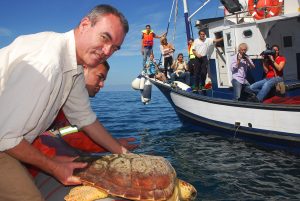
As the place of origin is not clear, the Canary Islands have been chosen as the release site. The rationale for this destination is that it is a relatively short flight, that the islands have a favorable climate, that good rehabilitation facilities are located there, and that it is located close to the North Atlantic Overhead or the entrance to the Mediterranean Sea if the turtle can find it.
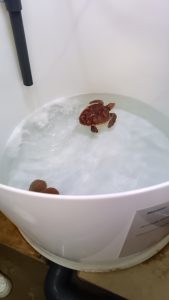
As the green sea turtle is generally found throughout the Atlantic Ocean, we are currently flying them to Gran Canaria for release — like the loggerhead turtle above — so that they can be transported by the North Atlantic Current.
Unfortunately, due to Brexit, CITES Export and Import permits along with a valid Health Certificate and Letter of Legal Acquisition are now required for this European destination.